Can you 3D print a jigsaw puzzle of the Moon?
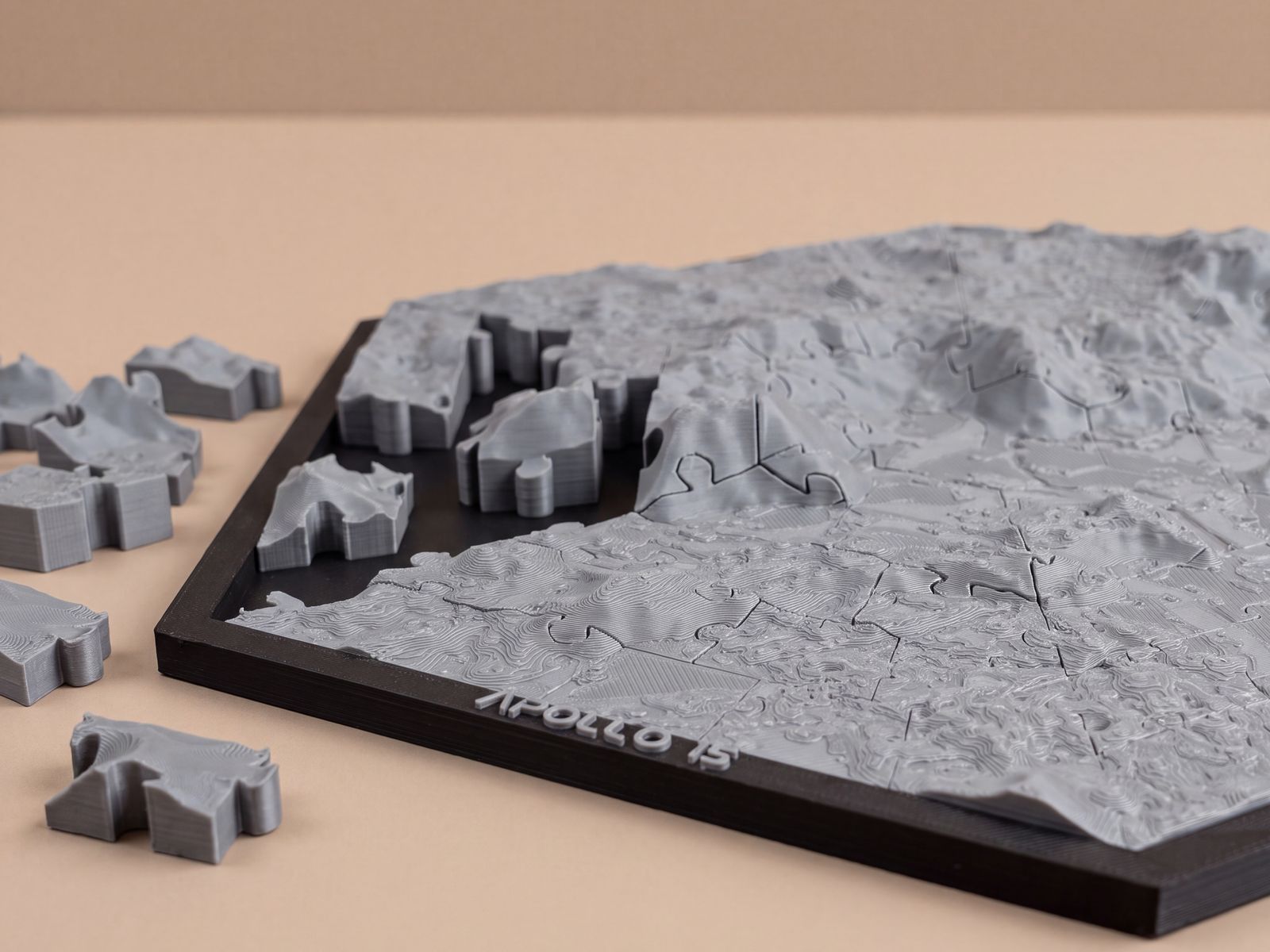
Yes. OrbitStudio turns any region of the Moon into a 3D-printable jigsaw puzzle, built from the elevation data of NASA's Lunar Reconnaissance Orbiter. You pick the region on a globe or a flat map, and the terrain is cut into interlocking pieces that sit in a frame. The picture on the puzzle is the relief itself: crater rims, terraced walls and central peaks, measured rather than sculpted.
The region is yours to choose: the nearside, the farside or the south pole, by hand or from 47 built-in landmarks, among them Tycho, Copernicus and all six Apollo landing sites. The puzzle is a circle, a square or a hexagon, 50 to 320 mm across, and nothing about it needs CAD or mesh repair.
How do you make a Moon puzzle?
In three steps, all in the browser. Open the generator, fly to a landmark or drag the selection box over any other region, pick the shape and press Generate Model; the terrain is built on OrbitStudio's server and shown in 3D. Set Model Type to Jigsaw Puzzle, choose the pieces, the size and the frame, and press Slice Puzzle. Then download the files and print them.
Generating a region and turning it around in 3D is free and needs no account, and a model made without one is kept for 48 hours. Cutting it into a puzzle and adding frame text take a free account. Only the download is paid, and what it costs is further down.
How many pieces does a Moon puzzle have?
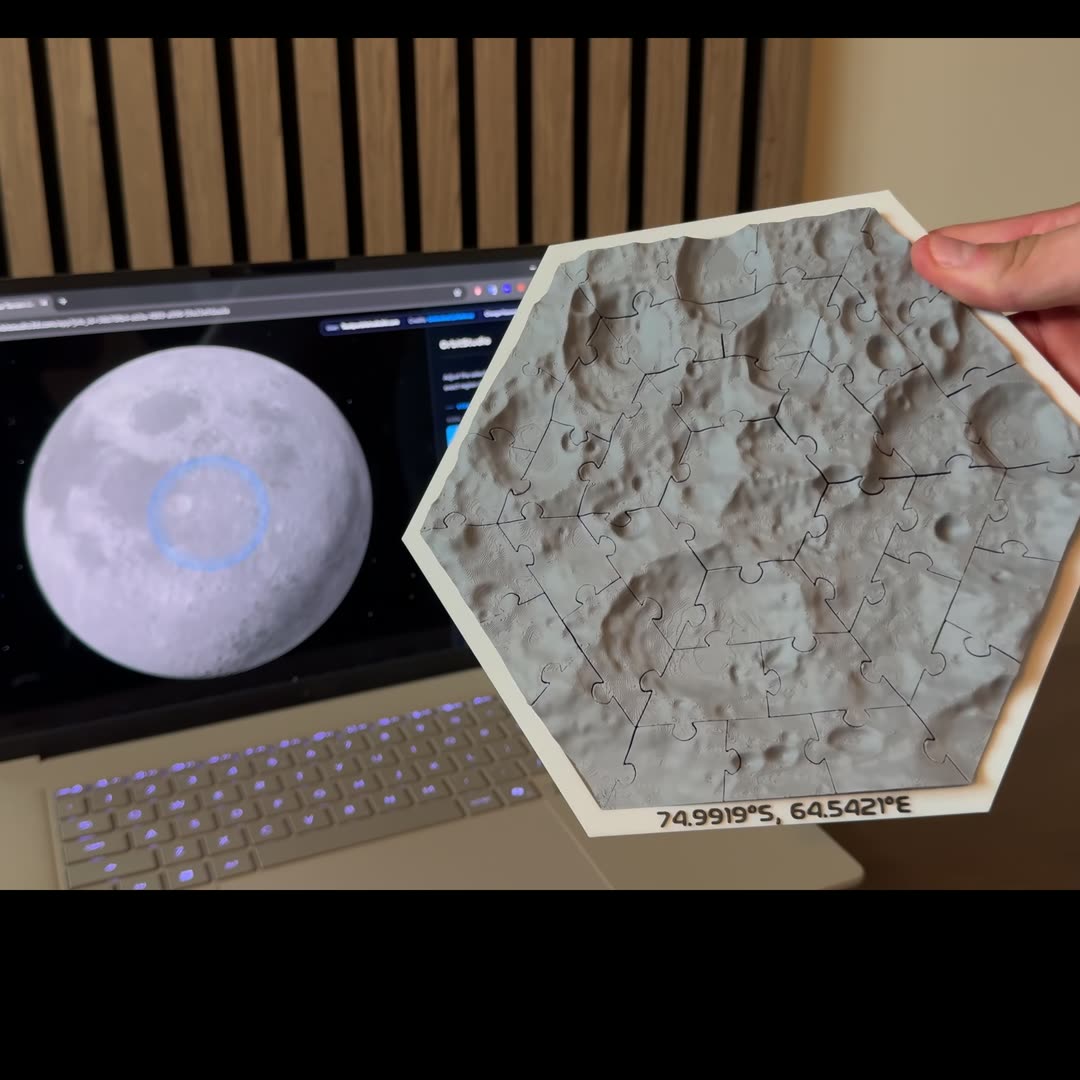
As many as you set, from 4 to 256. A square puzzle is cut into columns and rows, and its count is one multiplied by the other. A circle or a hexagon is cut into rings around a center piece. At the default size of 200 mm, a five-ring circle has 91 pieces, a five-ring hexagon has 61, and a square has up to 100.
The upper limits follow the size of the model, so that no piece gets too small: the sliders allow one column or row for every 20 mm of width and one ring for every 40 mm. At the largest size, 320 mm, that is 16 by 16 for a square, 256 pieces, or eight rings: 217 pieces for a circle and 169 for a hexagon. A Randomize Grid button redraws the cut lines when you want a different pattern.
| Circle, 200 mm | 2 to 5 rings: 19, 37, 61 or 91 pieces |
|---|---|
| Hexagon, 200 mm | 2 to 5 rings: 7, 19, 37 or 61 pieces |
| Square, 200 mm | 2 to 10 columns and rows: 4 to 100 pieces; 5 by 4, 20 pieces, to begin with |
What can you set besides the pieces?
The shape, the size, the relief and everything about the frame. A puzzle is a circle, a square or a hexagon, 50 to 320 mm across. Terrain exaggeration runs from 1x, which is true scale, to 20x, and the solid base under the terrain from 1 to 30 mm. The frame takes embossed or engraved text, a wall mount and a slide-on cover.
- Terrain exaggeration: at 1x heights are scaled exactly like distances. Deep craters read at 1x and mare plains need 3x to 5x; how far to go is your choice, and the 3D preview shows it before anything is cut.
- Base: the solid layer under the terrain, 3 mm to begin with. Nowhere is the terrain thinner than this.
- Frame: its base plate, border height and border width are each adjustable, and two buttons fit the border to the lowest or the highest edge of the terrain.
- Frame text: embossed (raised) or engraved, in six typefaces. Your own words, or the center coordinates of the region.
- Wall mount: a keyhole slot in the back of the frame, or screw holes through its base.
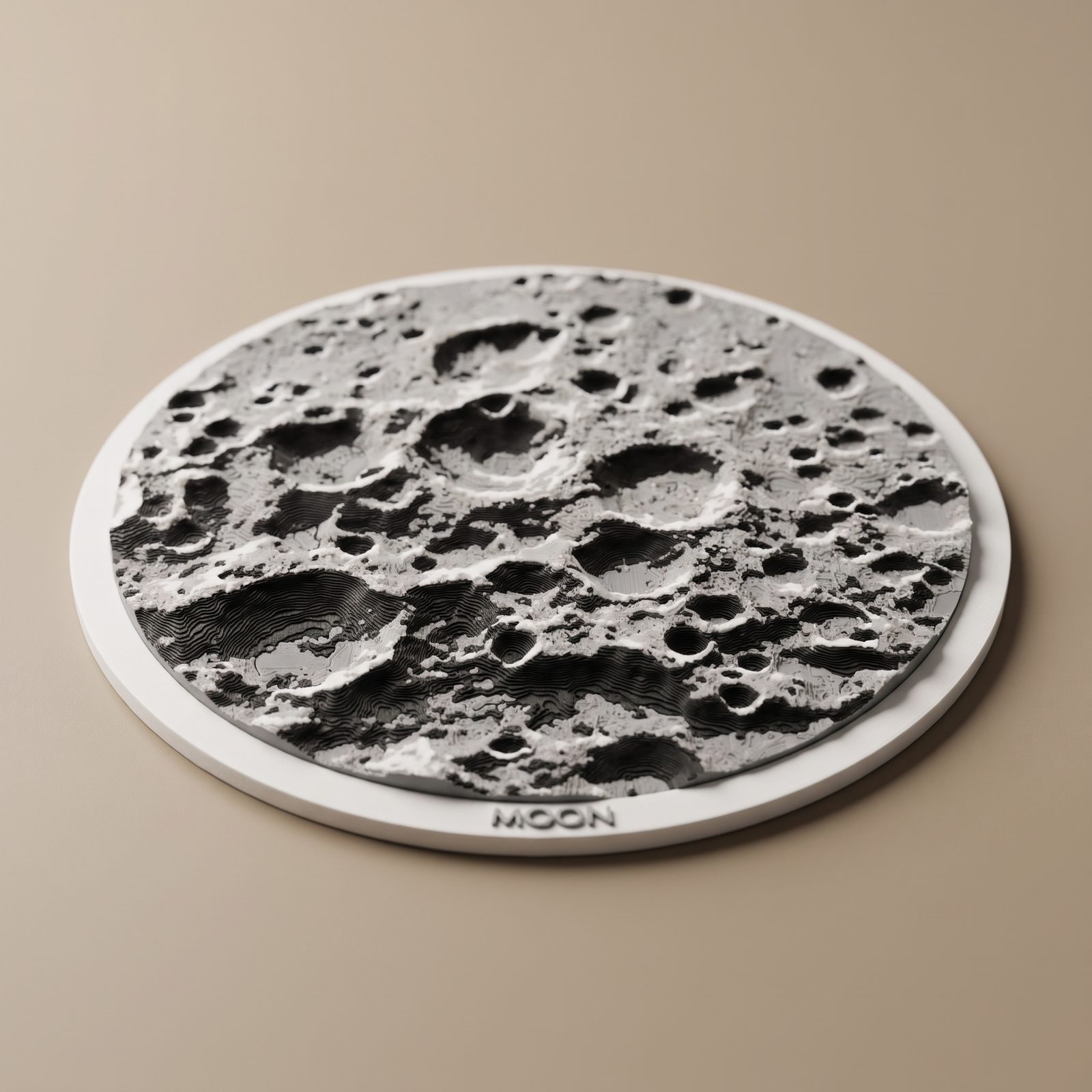
- Colors: each part gets a filament color in the app and the 3MF files carry it. The terrain's surface can also be printed in two to eight filaments, shaded from the Lunar Reconnaissance Orbiter's mosaic of the Moon; that takes a multi-filament printer.
The guide to printing the Moon works through the exaggeration numbers, and explains where the elevation data comes from.
What files do you get?
Two zip archives, one of STL files and one of 3MF files. In each, the terrain and the frame are separate files, and the cover is a third when the puzzle has one. The 3MF files already carry the colors for terrain, frame and text, ready for Bambu Studio or OrcaSlicer; with the STL files you assign the colors in your own slicer.
The terrain file holds every piece of the puzzle, and in the 3MF each piece is a part of its own. A model you bought on its own stays yours to download again at any time.
Which printer and filament do I need?
Any FDM printer whose bed fits the size you chose. A puzzle prints flat on its base, terrain up, with no supports. OrbitStudio's recommended settings are a layer height of 0.12 to 0.16 mm and 15% gyroid infill; matte PLA hides layer lines best, and silk PLA highlights the curves of the terrain.
Two colors are enough, one for the terrain and one for the frame, and because they are separate files a printer with a single spool can print them one after the other. Printers, profiles and materials vary, so check the geometry and the wall thickness in your own slicer before you start.
A printed puzzle is not a toy and is not suitable for children under 3: small interlocking pieces are a choking hazard. Keep the pieces away from small children and pets, and supervise older children.
Which regions of the Moon make a good puzzle?
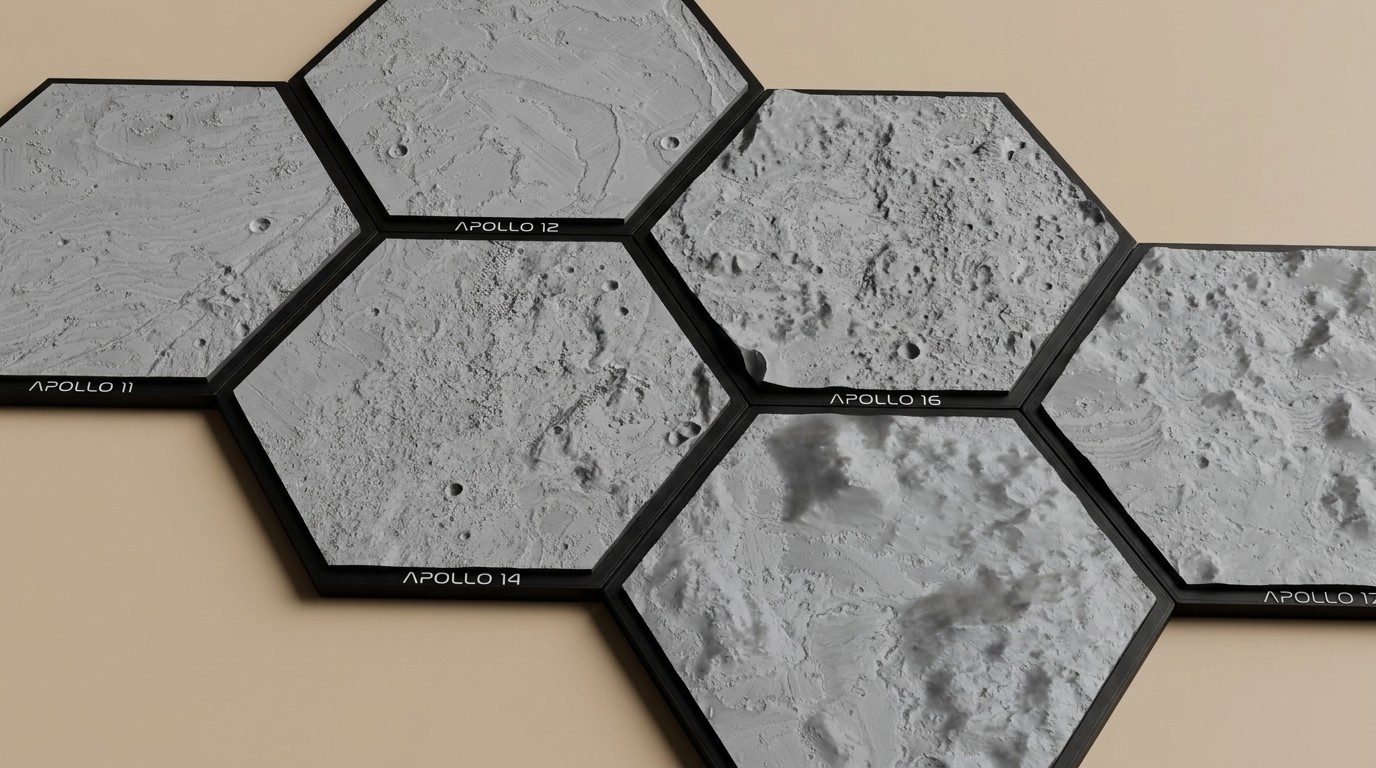
Regions with relief to spare, because on a terrain puzzle the height is the picture. Tycho, 85 km across and 4.7 km deep, reads at true scale, and so do the terraced walls of Copernicus. Among the Apollo landing sites, Apollo 15 is the one with relief at true scale: the Apennine mountains stand 3 km and more above the plain.
Mare plains are the opposite. At true scale the Apollo 11 site is close to a smooth plate with shallow dimples, so its pieces stay nearly flat until the exaggeration goes up to 3x to 5x. On the farside, Tsiolkovskiy puts a central peak over 3,400 m high on a flat floor 185 km wide.
Each of these opens the generator flown to that place, and makes the first model you generate there a jigsaw puzzle:
Does a Moon puzzle come with a lid?
Optionally. A puzzle can have a slide-on cover: a lid that slides over the finished model and onto its frame. Its fit has no settings: it is sized from your model, clearing the frame by 0.4 mm and the terrain by 0.2 mm, and it prints separately, flat side down. The lid can carry up to 40 characters of your own words.
Those words are inlaid in a second color, engraved, or cut clean through the lid so that the terrain shows through the letters. One caution, which the app gives itself when it applies: on very tall terrain the lid rests on the high ground and the lowest pieces keep a gap bigger than they are thick, so turning the model over can shake them loose. A lower terrain scale or a thicker base closes the gap.
What does a Moon puzzle cost?
Making one is free: generating and previewing any region needs no account, and a free account adds puzzle slicing, frame text and a library of three models. Downloading the files takes one model at $4.99 (€4.99), a Plus plan at $9.99 a month or $79 a year, a Merchant plan at $14.99 a month or $119 a year, or one credit from a backer's pass.
The plan prices are the same figures in euros. One model and Plus are for personal use; Merchant adds the right to sell the puzzles you print, and the files themselves can never be resold on any plan. The pricing page has every price and what each plan includes.
Can you make a puzzle of Mars or another world?
Yes. The same generator makes puzzles of Mars, Mercury, Venus, Vesta, Ceres, Mimas, Enceladus and Tethys, and of the sides of Pluto and Charon that the New Horizons spacecraft measured. Each world has its own elevation data and its own built-in landmarks, and a puzzle is made the same way: pick a region, choose the shape and the pieces, and slice.
Mars has 45 landmarks built in, from Olympus Mons to the places where rovers landed, and the guide to printing Mars covers its data and how much to exaggerate it.
More from OrbitStudio
OrbitStudio turns real elevation data from NASA missions into 3D-printable models, as jigsaw puzzles or solid ornaments, with terrain and borders already separated and colored. The Moon page lists every built-in lunar landmark with its coordinates, and Moon STL generators compared sets OrbitStudio beside the other ways to get lunar terrain as a printable file.
The night sky, too
OrbitStudio Sky, the night-sky tool, turns the sky over any place, on any date from 1900 to 2100, into a 3D-printable star map. Its STL is free.