The eight routes, side by side
Every row below was filled in from the tool's own page, read on 16 November 2026. Where that page says nothing, the cell says “not stated” instead of guessing. OrbitStudio's row comes from our own pricing page.
The table is wider than this screen: scroll it sideways.
| Tool | Price | Account | Lunar data | Worlds | What it makes | Files | Selling prints |
|---|---|---|---|---|---|---|---|
| OrbitStudio | Free to generate and preview. Download: $4.99 / €4.99 for one model, or a plan (Plus $9.99 a month or $79 a year; Merchant $14.99 a month or $119 a year), or a credit from a backer's pass. | None to generate and preview. A free account to cut a puzzle, add frame text and download. | NASA Lunar Reconnaissance Orbiter (LRO) elevation; the whole Moon, farside and south pole included. | 12: the Moon, Mars, Mercury, Venus, Jupiter, Pluto, Charon, Ceres, Vesta, Mimas, Enceladus and Tethys. | A snap-together jigsaw puzzle or a solid ornament; circle, square or hexagon; a frame with your own text; exaggeration, size, piece count and base thickness; 47 built-in lunar landmarks. | STL and pre-colored 3MF, together in a zip; terrain and frame are separate files. | With the Merchant plan or a Merchant pass. One model and Plus are for personal use. |
| MoonToPrint | Free; its terms call it a free open beta. Donations through Ko-fi. | Not stated. | LRO LOLA global model, about 118 m per pixel. | The Moon. | Terrain tiles of 120 mm or 200 mm: one tile, or a set (row, column, plus, 2x2, 3x3, round, quarter); optional standard or LED frame and keyhole wall mount; true scale or vertical exaggeration; base thickness; smoothing; an engraved badge. | STL. Its page notes that color is for the preview only. | Not without the operator's consent: its terms (12 February 2026) allow private, non-commercial use only, and do not allow passing the STL files on. |
| Moon2STL † | Free. † | None. † | The USGS ULCN 2005 elevation map, named in the tool's public code. | The Moon. | A square tile from a box you drag over the map: box size 4 to 10 degrees, vertical scale 0.5x to 4x. † | STL. † | Not stated. † |
| TerraPrinter | Free: “no fees and no paywalled exports”. Donations optional. | None: models can be made and downloaded without signing up. A free account is optional. | LRO LOLA, and the LOLA + SELENE/Kaguya merge. | Earth and 22 others, the Moon among them. | Styles: realistic, puzzle (48 pieces by default; grid, brick, hex or organic), Minecraft, tabletop. Shapes: rectangle, square, circle, hexagon, polygon, heart, star. Optional frame with an engraved label; vertical exaggeration; four Apollo sites to build from. | 3MF that keeps colors, STL (one per color, zipped), OBJ, GLB. | Yes, free of charge: “Free for personal and commercial use, including selling what you make. Keep the data credits.” |
| 3D Moon Map | Free to use: the page shows no price and no payment. | Not stated; the page asks for none. | The LRO LOLA elevation model; the page links the USGS 118 m global model. | The Moon. | An interactive 3D map of the Moon; Export STL saves the landscape in the 3D view; vertical scaling. | STL; also SVG and PNG pictures. | Not stated for STL files. |
| NASA Moon Trek | Free to use: a NASA web portal, with no payment step. | None asked for to open the 3D print tool; some of the portal's other tools ask you to register. | NASA's lunar elevation layers, served by the portal. | The Moon. | The terrain inside a rectangle you draw on the map; bounding box, resolution and height exaggeration settings. | STL or OBJ. | Not stated in the tool. |
| QGIS with DEMto3D | Free and open-source. An optional PRO version of the plugin costs €9.90 once. | None: desktop software you install. | Whichever elevation model you download, for example the USGS LOLA global model at 118 m per pixel. | Any world with a published elevation model. | A relief of the area you set by coordinates; scale, vertical exaggeration and base height. | STL. | Not set by the plugin: it depends on the license of the data you load. |
| The Terrainator | £5 a model, paid through PayPal. | Not stated; the site has a login. | Not stated. | Earth, the Moon and Mars. | A terrain model of the area you select. | STL. | Not stated. |
† Moon2STL's site did not respond on 16 November 2026, so its own page could not be checked. The cells marked † come from its listing in the SkipTheCAD directory, checked on 26 September 2026; the data source comes from the tool's public code, read on 16 November 2026. SkipTheCAD is run by SimplySolid3D, the maker of OrbitStudio.
Prices and terms change, so follow a tool's link for today's. If a cell is wrong or out of date, write to [email protected] and we will correct it.
Which Moon STL generators use real NASA data?
Most do. MoonToPrint, TerraPrinter and 3D Moon Map name LOLA, the laser altimeter on NASA's Lunar Reconnaissance Orbiter (LRO); OrbitStudio builds from LRO elevation data too, and Moon Trek is NASA's own portal. Moon2STL's code names an older USGS map, QGIS reads whichever elevation model you load, and The Terrainator's pages name no lunar source.
MoonToPrint states “DEM: LRO LOLA Global ~118 m/px”, and 3D Moon Map links the US Geological Survey's 118 m global LOLA model. TerraPrinter's license page credits “LRO LOLA and LOLA + SELENE/Kaguya TC merge”. OrbitStudio uses LRO elevation for the whole Moon, nearside and farside, the south pole included. What those data sets are, and how fine they go, is in our guide to 3D printing the Moon from NASA data.
Moon2STL's public code says its elevation models are “from the USGS ULCN 2005 dataset”, the Unified Lunar Control Network 2005, which dates from before LRO began measuring the Moon in 2009. With QGIS the choice is yours: the plugin converts any elevation raster you open.
Which are free?
Six of the eight are free to download from: MoonToPrint, TerraPrinter, 3D Moon Map, NASA's Moon Trek, QGIS with DEMto3D and, according to its directory listing, Moon2STL. The Terrainator charges £5 a model. OrbitStudio is free to generate and preview without an account, and charges for the download: $4.99 or €4.99 for one model, or a plan.
OrbitStudio's prices in full, from its pricing page: one model costs $4.99 / €4.99 once, and that covers its STL and its multicolor 3MF. Plus is $9.99 a month or $79 a year for unlimited downloads for personal use. Merchant is $14.99 a month or $119 a year and adds the right to sell prints. Campaign backers download with a credit from their pass. So it is a subscription only if you choose one: a single model is a one-time purchase.
Free can come with conditions. MoonToPrint's terms describe a free open beta for private, non-commercial use. TerraPrinter asks you to keep the data credits. DEMto3D is free from the QGIS plugin manager, and its site sells an optional PRO version for €9.90 once.
Which can make a puzzle?
Two: TerraPrinter and OrbitStudio. TerraPrinter has a Puzzle style, 48 pieces by default, with grid, brick, hex or organic piece layouts. OrbitStudio builds every model as either a snap-together jigsaw puzzle or a solid ornament, in a circle, a square or a hexagon, with a frame the pieces sit in and a piece count you set.
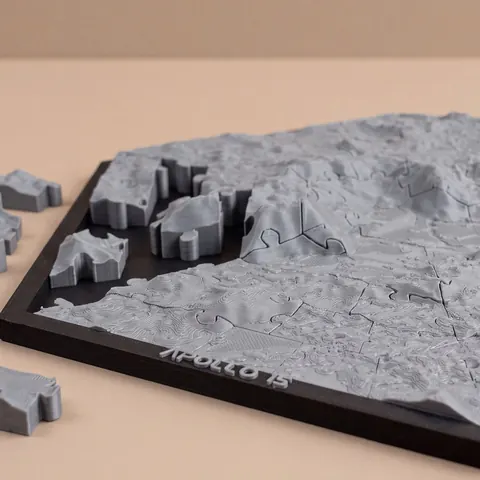
MoonToPrint makes sets of tiles (2x2, 3x3, round, quarter) to hang or assemble together; its page does not mention jigsaw pieces. The other tools export one solid piece, and cutting that into a puzzle would be a job for CAD software.
Which make multicolor files?
Two write color into the file. TerraPrinter's 3MF “keeps colours”, with a part for each color, and it also zips one STL per color. OrbitStudio delivers a zip of STL files and pre-colored 3MF files, with the terrain and the frame as separate files, ready for Bambu Studio or OrcaSlicer. The other six export a single-color STL; Moon Trek also offers OBJ.
A single-color STL is not a dead end. A slicer can change filament at a chosen layer, and the Moon guide explains how, together with the layer height and infill that keep the craters.
Can I sell prints made with them?
It depends on the tool, and three of them state a rule. TerraPrinter allows it free of charge, as long as the data credits stay with the listing or the print. OrbitStudio allows it with the Merchant plan ($14.99 a month or $119 a year) or a Merchant pass. MoonToPrint's terms allow private, non-commercial use only, unless its operator agrees. The other five do not say.
“Not stated” is not permission. Where a tool says nothing, ask its maker before you sell. With QGIS the question moves to the data: the plugin sets no rule for what you make, so read the license of the elevation model you load. On OrbitStudio the Merchant license covers physical prints, never the files themselves.
Are there ready-made Moon models to download?
Yes. NASA's 3D Resources is a repository of 3D models, printable models and textures that are “free to download and use”. It lists models of Apollo landing sites, among them an STL height map of a 30 by 30 km area around the Apollo 11 site, exaggerated 60 times. Libraries such as Printables and Thingiverse hold Moon models uploaded by their makers, each under its own license.
A ready-made model is the quickest route when somebody has already made the place you want, at the size you want. A generator is for choosing the region, the size and the exaggeration yourself.
Is a lithophane moon lamp the same thing?
No. A lithophane is a thin plate or shell that shows a picture when light shines through it: thicker plastic lets less light pass and reads as darker. A moon lamp is a lithophane wrapped around a sphere and lit from inside, typically made from pictures of the Moon's surface. The tools above make terrain instead: a solid relief whose heights are the Moon's measured heights.
TerraPrinter, for one, also offers a lithophane of the Moon's phase on a date you choose, made from the Lunar Reconnaissance Orbiter's wide-angle camera mosaic. Both kinds of print can start from LRO, but one shows brightness, lit from behind, and the other shows height.
Which one should you choose?
For a plain, single-color piece of the Moon, a free tool is the better choice: MoonToPrint for a framed tile or wall set at home, 3D Moon Map or Moon Trek for a quick STL of one region, TerraPrinter if you also want colors, a puzzle or the right to sell. OrbitStudio is for a finished multi-part model: a puzzle or a framed ornament with text, in pre-colored files.
OrbitStudio is one of the two paid tools here, and what the price buys is the finishing: a jigsaw puzzle that snaps together, or an ornament; a frame with your own words embossed or engraved around it; terrain and frame as separate pre-colored files; 47 built-in lunar landmarks, from the six Apollo sites to the south pole; and the same tool for eleven other worlds. You can generate any region and turn it in 3D for free, with no account, before you decide.
QGIS with DEMto3D is the route for full control, if you already work with GIS data or want to learn it; the Moon guide walks through it and through Moon Trek. The Terrainator fits when you want one STL of Earth, the Moon or Mars and would rather pay per model.
Looking for the sky instead of the ground? We compared star map generators for 3D printing the same way.