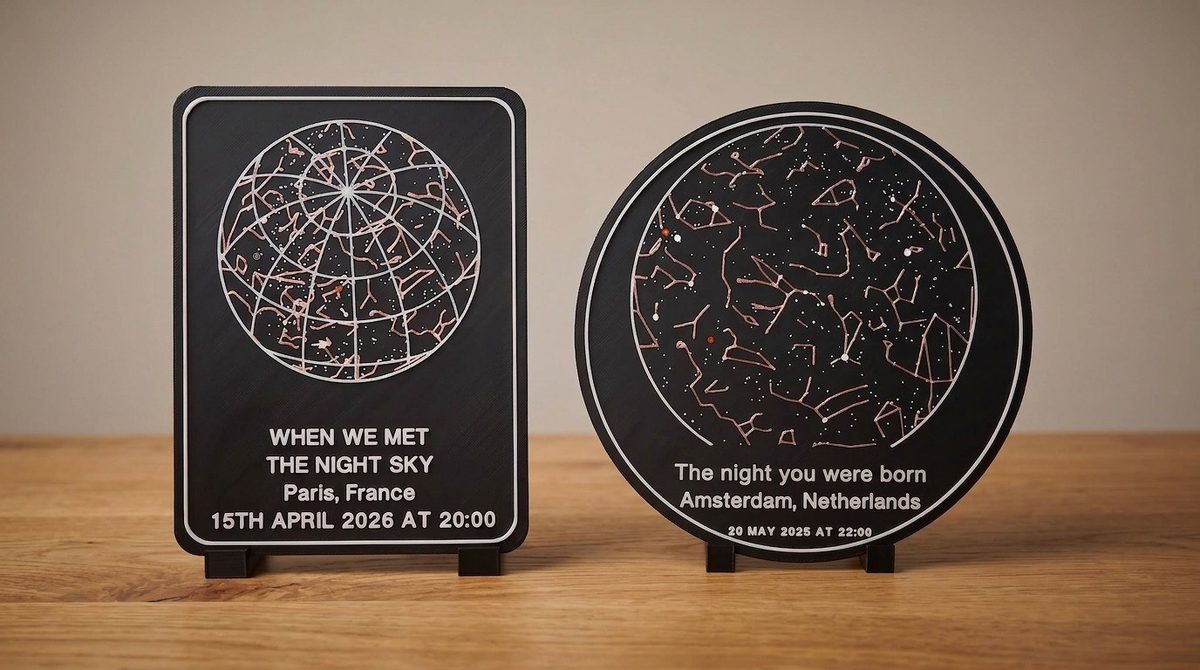
Which night should the star map show?
The one the person would name first if you asked. People print births, proposals, weddings, first homes, anniversaries and memorials, and most of those start from a date somebody already keeps: a birth certificate, a wedding invitation, the timestamp on a photo. Three of them have a guide of their own: the night you met, a wedding and a birth.
The place matters as much as the date. A star map is the sky over one spot, so a proposal in Paris and the same evening in Chicago give two different plates. The hour matters most of all. The sky turns about 15 degrees an hour, so use the clock time people remember, not "sometime that evening".
What should you write on it?
The plate has room for five lines, each at its own size: a title, a message, the place, the date and time, and the coordinates. A gift rarely needs all five. A title, the place and the date are often enough; the stars do the rest.
Keep the title short and personal: THE NIGHT YOU ARRIVED, WHEN WE MET, THE NIGHT YOU SAID YES. The message line takes a name, a line of your own, or a heart (♥ and ♡ both work). The lettering keeps the capitals you type, except in Cinzel, which draws small letters as smaller capitals.
If a name has an accent, pick a font that draws it. Helvetiker doesn't; the other five do. All six were measured against a 0.4 mm nozzle, so the letters come off the printer whole instead of as broken strokes.
Which shape and finish suit a gift?
The plate comes as a rounded rectangle, a rectangle, a circle or a hexagon. A circle looks most like a window onto the sky, but it has less room for words than a rectangle. Every plate writes the month short by default, 17 SEP rather than 17TH SEPTEMBER, which keeps the date line large enough to print.
For a shelf, add the desk stand; the credit that pays for the chart's multicolor 3MF covers the stand as well. For a wall, leave the keyhole for hanging switched on, as it is by default.
Two colors already look finished: a dark plate with light stars and lettering. The multicolor 3MF arrives with every part colored, the stars, the constellation lines and each planet, so a third color is a matter of picking filaments from a list. The plates in these photos use copper for the constellation lines.
How do you print it?
Flat on the bed, face up, without supports. Everything on the plate stands up from its flat top, so there is nothing to cut away or sand. The stars are raised by brightness, from 0.4 mm for the faintest to 1 mm for the brightest, which is why even a one-color print still reads as a sky.
With a single extruder, download the STL and add one color change at the first layer above the plate's top; everything raised then prints in the second color. The full walkthrough is in how to 3D print a star map of a specific night.
When is it too late to make one?
Later than you might think. This one comes off your own printer, so there is no shipping date to beat; the only deadline is your printer's queue. Slice it first to see how long your plate takes with your settings, and leave room for one test print.
What does it cost?
Making the star map and downloading its STL is free and needs no account. The multicolor 3MF, with its colors already assigned, uses one credit from a pass. That credit also covers the chart's desk stand, and downloading the same chart again is free. A pass works in both OrbitStudio tools: Sky for the night sky, Terrain for the Moon and Mars.