Where do you find the exact time of birth?
Often on the birth certificate or in the hospital record, and on the birth announcement the family sent out. The hour matters because the sky turns about 15 degrees an hour: a star map for 03:12 and one for 04:12 are turned 15 degrees apart, which is easy to see.
If only the date is known, you can switch the time off the date line and chart an evening hour of that day, so the plate doesn't claim a precision it doesn't have.
What if the baby was born in daylight?
The stars were there anyway, hidden by the sun, and the star map shows them as they stood. The studio tells you when the sun was up at the moment you chose. You can chart the birth hour itself, or the first night at home.
Can you chart a birth from decades ago?
Yes, any date from 1900 to 2100, which covers a grandparent's birth as easily as this year's. One caution for old dates: before about 1970 time-zone records are patchy, so the offset used can be up to an hour out. For a birth that old, check the local time against a family document if you can.
That also makes it a Mother's Day or Father's Day gift: the night their child was born, or the night they were.
What should the words say?
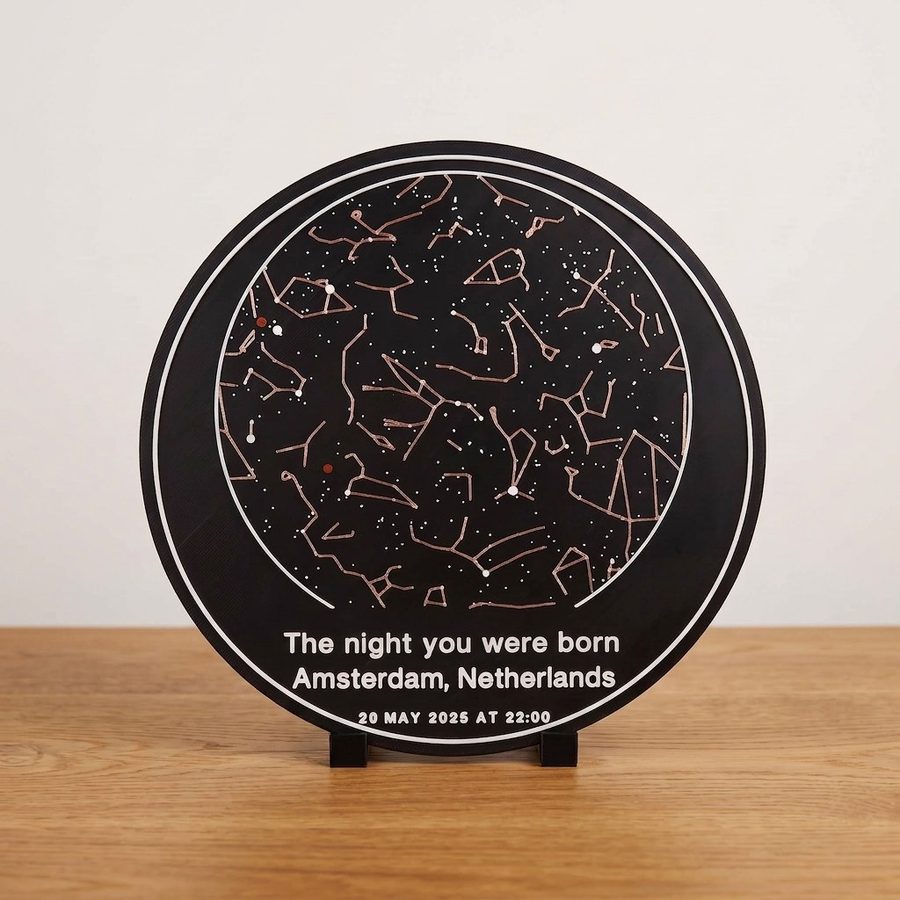
A name as the title, or a line like THE NIGHT YOU ARRIVED, the studio's own starting point for a birth. The place and the date follow underneath. The round plate in the photo reads The night you were born, Amsterdam, Netherlands and 20 MAY 2025 AT 22:00, in capitals and small letters just as it was typed.
Open the Amsterdam example in the studio, or start from First breath, the preset for a birth, and change the details to yours. Making the chart and its STL is free and needs no account; the multicolor 3MF uses one credit from a pass.